Impressionist Light
Bridging Artistic Spontaneity & Industrial Constraints
Textile Designer & Researcher | 2017 Academic Project

"The Water Lilies - The Clouds" by Claude Monet, MoMA NY. Photographed during my research visit in 2017.
Overview
Design Research This project explores the intersection of fluid art and rigid manufacturing. The challenge was to replicate the sensation of an Impressionist painting using screen printing - a technique typically designed for flat, uniform surfaces.
The Inspiration
My research began with the selection of Monet's "The Water Lilies - The Clouds". I identified that my own drawing style naturally resonated with Impressionist qualities. I was captivated by how the painting creates a sense of serenity, despite being created during the chaos of war.

My Goal: To translate this emotional depth and "painted light" into a functional textile product.
The Challenge
The Brush vs. The Screen Impressionism relies on the direct, spontaneous application of pure color using a flexible brush. In contrast, screen printing is an industrial technique based on a fixed, rigid mesh (the screen).
Hand Painting


Screen Print


The Manual Experiment
I started by mimicking Monet’s technique manually, using a spatula to apply acrylics directly to canvas, creating rich, organic textures.
The Industrial Gap
When trying to transfer this to a screen, the result became binary and flattened. The screen "cleaned up" the messiness that gave the work its character.


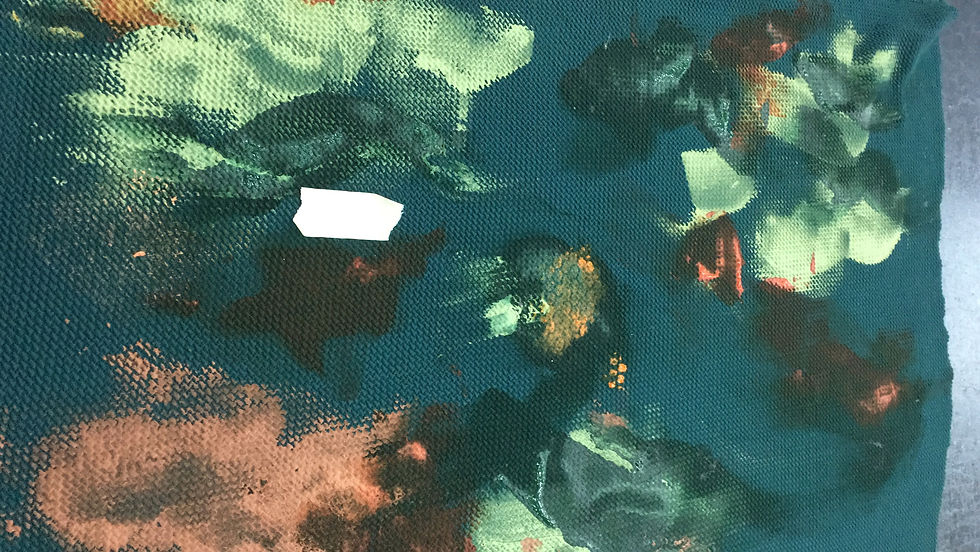


The Core Conflict
How can a static, mechanical grid replicate the organic, vibrating depth of a painting?
The Process & Methodology
1
Tooling: Redefining the Brush
To bridge the gap between art and industry, I had to create a new language for print.
The Adaptation
A brush creates soft, fading edges that disappear during screen exposure. I needed a tool that leaves a distinct, binary mark.
The Solution
I replaced the brush with a spatula. I mimicked the Impressionist movement but applied it to a tool that creates sharp, defined textures suitable for the "pixelation" of a mesh screen.


2
Translation: From Analog to Digital
Once the textures were created manually, they had to be translated into a format the machine could read.
The Negative
I scanned the spatula textures and processed them into high-contrast black and white films (transparencies). These films act as the "code" for the screen.
The Variable
UV Exposure Time.
The Experiment
I conducted a series of tests, exposing screens at different intervals: 2:30, 3:00, and 3:30 minutes.
The Result
I washed out the screens manually to inspect the resolution. The tests revealed the "Sweet Spot" time that preserved the organic "noise" of the texture while maintaining the structural integrity of the screen.


3
Calibration: The Exposure Tests (A/B Testing)
The most critical phase was optimizing the screen exposure to capture the finest details of the texture.
The Design
Final Product: The Light Interface
The result is a textile curtain that functions as a dynamic light filter for the home.
The Experience
By overlapping the semi-transparent screen prints, I created a complex visual depth. As sunlight hits the fabric, the "pixels" of the screen print decompose the light, filling the room with the same serene atmosphere found in Monet's paintings.


